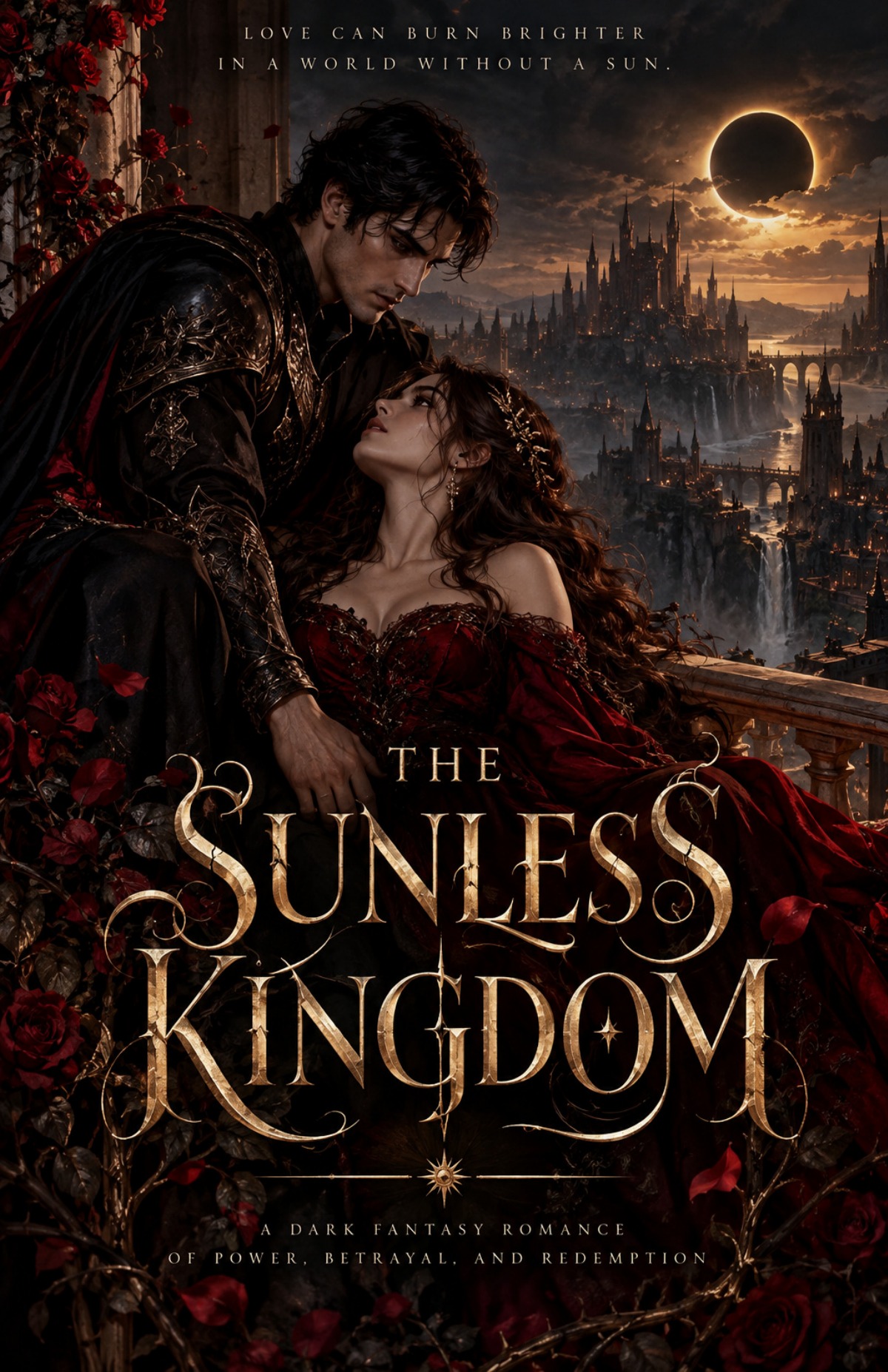
The first time Adrian Vale came to my kingdom, he brought a sunrise in a box.
I was busy trying to keep a woman from hitting her husband with a jar of preserved pears.
“You promised my mother you'd fix the bell,” the woman said, her voice carrying magnificently across the Night Market. “Not trade it for wine.”
“I traded it for lamp oil,” her husband protested.
“That makes it worse.”
I stepped between them before the jar could become evidence in a hearing I had no intention of attending.
“Give me the pears, Nessa.”
She drew them out of reach. “He sold the bell, Captain.”
“And I imagine he'll be hearing about it for several decades. I'd hate for you to waste good pears on him in the meantime.”
Around us, the market went on with the indifference of a place accustomed to marital disaster. Blue lanterns drifted over the stalls on silk tethers. Vendors shouted their prices from beneath awnings stitched with tiny pieces of mirror glass. Somewhere farther down the street, a child was winning a loud argument with a goose. The goose, by the sound of it, had been winning first.
Nessa looked from the jar to her husband. Her mouth tightened. Then, very reluctantly, she put it in my hands.
“I'm not forgiving him.”
“I wouldn't dream of asking.”
Her husband gave me a grateful nod. I returned a look that told him gratitude would be better expressed by retrieving the bell.
It wasn't an especially glorious way to begin a day as captain of the eastern Veilwardens, but it was my city. I preferred its small disasters to the large ones that kept trying to cross our borders.
A thousand lights trembled above the market, and not one of them came from the sun.
The roofs of Lower Nhalis curved beneath the great dark ceiling of the Veil, so high above us it sometimes vanished into the mist. Through the glasswork, the light of the upper world reached us softened, split, stripped of its killing edge. In the gardens and canals, nightbloom gave the rest back: pale violet blossoms, silver fish beneath the bridges, blue-green vines threaded through the ironwork of our houses. Visitors called it beautiful as though beauty must be an accident in a place without daylight.
To us it was Tuesday.
“Captain Laurent!”
I turned in time to catch a wooden fox thrown at my head.
“That's a dangerous way to greet an officer, Tavi.”
The boy stopped short, grinning. He was sixteen, all elbows and unruly hair, and wearing the leather apron of a glassworker as though it entitled him to command the street.
“It wasn't supposed to hit you.”
“It nearly did.”
“That's why it has a tail. Balance.”
I examined the fox. Its small body was carved from riverwood, its belly fitted with a piece of blue nightglass. The light inside had dimmed, but the craftsmanship was unmistakable.
“Liora made this?”
“Most of it. I fixed the tail.”
“Then the tail is probably what's wrong.”
“You sound exactly like her.”
“An honor I've been trying to earn for years.”
Tavi fell into step beside me as I crossed the market. From the corner bakery came the smell of yeast and toasted fennel. On a balcony above us, an old man watered a row of silverleaf plants while singing with enough enthusiasm to make the tune difficult to identify.
“Liora wants you,” Tavi said.
“Is she hurt?”
“No. Angry.”
“That doesn't narrow it down.”
“She says the western condenser is making a noise like a married man who's just been caught.”
“That sounds serious.”
“She says you've been ignoring her letters.”
“That sounds more serious.”
Tavi's grin faded a little. “She's written six.”
“I've read them.”
“And?”
“And I have a meeting with the sun delegation in eighteen minutes, and she'll have to settle for me looking properly ashamed afterward.”
He considered this. “She won't.”
“I know.”
We reached the Square of Bells, where the road broadened around a shallow pool fed by an underground spring. Children floated paper boats along its stone edge. Each boat carried a pinprick of safe blue light, and the current drew them together until they resembled a tiny drifting constellation.
One little girl sat apart from the others, frowning at a boat that refused to move.
“Minna,” Tavi called. “The water goes the other way.”
“It knows what I want,” she informed him.
“She has your confidence,” I said.
“She has Liora's,” Tavi replied.
The child looked up at me. A purple ribbon held back her curls, badly tied. She had a scrape on one knee and the determined expression of someone prepared to dispute the laws of nature.
“My boat won't go to the bridge.”
“Perhaps it likes this end of the pool,” I said.
“Then it should have been somebody else's boat.”
I crouched and nudged the little paper prow into the current. It caught, turned, and joined the others.
Minna watched it go. “I knew that would work.”
“Of course you did.”
“Liora says the trick is making the world think your idea was its own.”
I stood. “Don't let anyone tell you Liora is a good influence.”
From the far side of the square came the first strike of the gate bells.
One. Two. Three.
The market noise faltered. Tavi's smile disappeared.
There were seven bells at the eastern gate. Three meant the delegation had crossed the ridge; four more, when they sounded, would mean its escort was at the city doors. We had agreed to admit eight visitors, no siege equipment, no heat weapons, and no unfiltered light source larger than a handlamp. I had read the agreement so many times that the words had begun appearing behind my eyelids when I tried to sleep.
“Tavi, take Minna to the workshop.”
“I'm supposed to help with the welcome.”
“This isn't the kind of welcome you want to help with.”
He opened his mouth, saw my expression, and closed it again.
“Fine,” he said. “But if they bring those ridiculous gold helmets, I'm drawing one.”
“Make sure you get the ears right.”
He ran toward the pool. I watched until he had Minna by the hand and was leading her into the crowd.
Then I went to meet the people who had come to improve our lives without asking how we lived them.
* * *
The eastern gate was built into the side of the ravine, under seven ribs of black glass. Beyond it lay the border passage and, beyond that, a world whose light could blister my skin.
My second-in-command, Elias Renn, waited by the inspection dais with his arms folded. He had a scar through one eyebrow and the unhurried patience of a man who had spent ten years waiting for me to admit he was right about things.
“Your collar is crooked,” he said.
“Good morning to you too.”
“You're supposed to be receiving a military envoy, not arresting a baker.”
“Bakers are more dangerous. They know everyone's weaknesses.”
He adjusted my collar with the familiarity of someone who had done it since we were cadets. “The Council sent three observers. Corven brought six.”
“Of course he did.”
“He's also brought a speech.”
“Then we may have to declare war before lunch.”
Elias's mouth twitched. “I was hoping to avoid that.”
The gate bells finished their sequence.
I straightened my coat and stepped onto the dais. The pale lines of my Veilwarden insignia caught the lamp glow. Beneath my sleeve, the old sun scar along my left forearm had begun to ache. It always did when I thought about the border for too long, which was inconvenient when the border was my job.
The outer doors rolled aside.
Eight visitors entered beneath a halo of filtered glass. Their boots made a hard, unfamiliar music against the stone. I recognized the colors before I recognized the faces: the gold-and-white of Aureth's sun guard, an aggressive sort of brightness in a place where people had spent generations learning to soften it.
At their center walked a man carrying no helmet.
He was taller than I had expected, broad through the shoulders, with dark hair that refused to stay as neat as his uniform. A narrow scar crossed the edge of his jaw. His black-and-bronze coat was cut for movement rather than ceremony, and the way the soldiers behind him kept half a pace back suggested he didn't need to ask for room.
Adrian Vale.
I'd read his operational reports. Several had cost me sleep. One had cost us the use of a supply road for an entire winter.
He stopped before the dais and studied the great arches overhead, then the crowd behind the railings. His expression didn't change much. Still, I caught the precise moment the wonder of the city reached him. Most Aureth officers stared at Nhalis as though expecting to see its inhabitants crawling along the walls. He looked at the engineering first, the people second, and the weapons last.
Interesting order.
“Captain Laurent,” he said.
His voice was low and steady. Not loud, but it traveled.
“Commander Vale.”
“I appreciate your agreeing to receive us.”
“I appreciate your leaving the catapults at home.”
One of his officers stiffened. Vale's eyes returned to mine.
“They're difficult to pack.”
Elias coughed into his fist. I kept my face composed.
“Our agreement limits this visit to an inspection and a proposal,” I said. “No alterations to the Veil. No activation of equipment without authorization from both councils.”
“Understood.”
“You've brought a demonstration case.”
His gaze slid toward the rectangular box carried by the youngest of his engineers. Brass fittings, sunproof seals, a double skin of reinforced glass. A faint gold line glowed beneath the lid.
“A scale model,” he said. “Designed to show you where the pumping power would come from.”
“I know where it would come from.”
“Then we can save ourselves the mathematics.”
“I know who would lose it, Commander. The mathematics is what worries me.”
A slight pause. He didn't seem offended. That worried me more.
“Perhaps you'll allow me to explain what the revised allocation actually does.”
“And perhaps you'll refrain from demonstrating it in a city full of people who can't survive a mistake.”
Something tightened in his face at that. Not anger exactly. The expression of a man who had met resistance before and had never entirely learned to enjoy it.
“Captain,” he said, “there are settlements on my side of this ridge where mothers are boiling river mud to get enough water for their children. I'm not asking you to trust me. I'm asking you to look at what we've built.”
I had prepared answers for arrogance. I hadn't prepared an answer for hungry children.
I knew the shortages were real. Sera had treated Aureth refugees at the river clinic; I had signed the medicine reports myself. Knowing it didn't make the next part any easier.
“And when your pumps draw the heat they require?” I asked. “What happens to our condensers?”
“They'll operate at reduced efficiency.”
“How reduced?”
“We have a range.”
“Tell me the worst number.”
He held my gaze.
“Eighteen percent in the eastern districts.”
Elias went still beside me. On the other side of the dais, Corven Tair muttered something sharp to his assistants.
Eighteen percent was not a number anyone in Nhalis could afford to call small. It was winter stores, clinic lamps, the temperature of infant wards, and the wet air drawn through our garden vaults. A number that could be drawn with ink by someone who would never have to sleep beneath it.
“You've come to ask us for almost a fifth of our protection,” I said.
“I've come to show you a way to prevent a famine.”
“They aren't the same thing.”
“I know.”
For the first time, I believed him about something.
It was the wrong thing to find reassuring.
Corven stepped forward in his ceremonial blue, ready at last to enjoy his speech. “The Council will not consider—”
“Councilor,” I interrupted, “we agreed the technical demonstration would be examined before debate.”
His pale eyes narrowed. He didn't like a soldier remembering procedure better than he did.
Vale looked briefly at me. If he was surprised to be granted anything, he hid it well.
“Three minutes,” I told him. “With your engineer and mine beside the case. All seals remain intact.”
“Agreed.”
It would have been a good moment for the world to behave exactly as promised.
Unfortunately, worlds rarely read agreements.
The Aureth engineer set the brass case on the stone plinth. Elias leaned in to check the clamps. The demonstration was supposed to be harmless: a ribbon of amber moving through dark glass to indicate how the new pumping engine would borrow power from the Veil. Light represented by light, nothing more.
Vale pointed to the first narrow channel. “This is your existing allocation to the eastern condensers. Our proposed alteration routes the excess into a thermal turbine, which would raise the water above the dry ridge.”
“Excess,” Elias repeated. “A generous word.”
The engineer turned a small key.
Inside the box, a bright line traveled through three curved panes. I watched the readout needles. One, two, three. The fourth trembled.
I knew that kind of tremble. Every Veilwarden did.
“Stop,” I said.
The engineer looked up. “Captain?”
“Don't turn it again.”
For half a second nobody moved. Then the fourth needle slammed against its limit.
A thin golden seam appeared across the lid.
It was no wider than a thread, but my skin recognized it before my eyes did. Heat struck my cheek. Beneath my left sleeve, the scar flared as if someone had laid a coal against it.
“Seal it!” Vale ordered.
The engineer reached for the key. Too slow.
I shoved him aside and brought the shield from my belt up between the broken seam and the market railings. The shadeglass disc snapped open with a metallic crack, a dark blue circle against the burst of gold.
I had seven minutes beneath a full sun. Against a leak this narrow, I'd need seconds.
The case split along one corner.
Light punched across the dais and scattered against the polished stone. A little girl cried out.
Minna.
She'd slipped away from Tavi and was standing at the rail, one hand raised to protect her face. A line of raw sunlight ran across the hem of her sleeve.
I moved before I had time to be frightened.
“Down!” I shouted.
Elias seized Minna and pulled her clear. Vale's next command came with the violence of a hammer striking metal.
“Close the outer shutter. Now.”
His guard hesitated: shutting the shutter would trap the Aureth equipment in the dark chamber, cut their retreat, and break half the expensive mechanism.
Vale didn't repeat himself.
He grabbed the release lever and drove it down with both hands.
The brass case buckled. The hard beam vanished. My shield drank its last scatter and shrieked as the glass overheated.
For one long breath, the gate chamber remained completely still.
Then Minna began to cry in earnest.
I folded my ruined shield, crossed the dais in three strides, and knelt beside her. Elias had wrapped his cloak around her shoulders. Her forearm bore a narrow pink welt, no deeper than a kitchen burn, but I knew what that meant. The damage from unfiltered light could deepen over the next hour.
“Look at me, sweetheart.”
Her lower lip trembled. “I wasn't supposed to come.”
“No,” I said, keeping my voice steady. “But that's a conversation for another day.”
“Is it going to hurt forever?”
I wanted to promise it wouldn't. I had learned, painfully, not to make promises about injuries I couldn't yet see.
“Sera's very good at making hurt smaller,” I told her. “We're going to let her look.”
Minna nodded, fierce even through her tears.
A shadow fell across us.
Vale stood a few paces away, one sleeve singed, the hard muscles of his jaw working. Behind him, his engineer was whispering apologies that sounded more like prayers.
“Is the child safe?” Vale asked.
“She will be assessed,” I said. “You've finished your demonstration.”
“That filter was tested.”
“Then your tests were wrong.”
His gaze flickered to the welt on Minna's arm. He didn't ask me to consider his intentions.
“You're right,” he said.
I looked up, startled by the answer.
He turned to his engineer. “Seal the damaged unit. No one touches it without a joint inspection. Every note from the testing room goes to Captain Laurent before nightfall.”
“Commander, the Assembly classified the—”
“Then the Assembly can complain to me.”
The engineer swallowed. “Yes, sir.”
Minna had begun to hiccup quietly against Elias's coat. I touched her good shoulder and rose.
“Your people nearly burned a child in her own city,” I said to Vale.
“I know what happened.”
“Do you?”
He faced me without looking away. There was something formidable about the way he held himself: a man accustomed to danger, who had no desire to pretend danger was somebody else's mistake.
“I'll have the defect traced,” he said. “You'll have the results.”
“And the proposal?”
“My people are still thirsty.”
For a moment I heard only the cooling tick of broken brass.
Mine are still vulnerable, I wanted to say. Mine are still alive under a ceiling you can dim with a turn of a key.
But I thought of the families in dry settlements. I thought of Minna's forearm and the fear in her eyes.
“You can show your Council whatever you like,” I said. “You will not turn my home into a test chamber again.”
Vale's expression grew colder.
“Then help me find another chamber, Captain.”
He said it like an order.
I moved close enough that he had to lower his gaze to keep looking at me. Behind us, his soldiers shifted their weight; mine did the same.
“Here's something you should know about me, Commander.”
His eyes didn't leave my face. “I'm listening.”
“I don't take orders from men who arrive with the sun in a box.”
Something unreadable crossed his features. Not amusement. Not quite anger.
“Then it's fortunate,” he said, “that I didn't come here looking for obedience.”
“Good.”
“I came looking for someone willing to tell me the truth.”
I glanced toward the broken case. “You've found her.”
His mouth tightened.
“I suspect,” he said, “that's going to be the difficult part.”
* * *
That evening, after the officials had finished arguing and the engineers had been locked in a room to argue more usefully, I went to Sera's clinic.
Minna was asleep. Her arm had been dressed with cooling salve; Sera said the damage was superficial, though we'd have to watch it for another day. On the stool beside her bed sat a familiar wooden fox, its blue belly shining faintly.
“Liora sent it,” Sera told me.
She was rinsing instruments in a basin. A strip of hair had escaped her braid and stuck to her cheek, and there were shadows beneath her eyes that hadn't been there when we were nineteen and sure skill would make the world fair.
“How is she?” I asked.
“Liora? Furious. She's repairing your shield and composing an insult for the envoy. She says both tasks are taking longer than expected.”
“Poor envoy.”
Sera set down a cloth. “Viv.”
I knew that tone. I didn't turn.
“I'm fine.”
“I didn't ask.”
“That never stops you.”
“Show me your arm.”
I pulled back my left sleeve. The old scar was red and angry but unbroken. Sera pressed two cool fingers to the skin, testing the heat beneath it.
“You were too close.”
“It was a narrow beam.”
“A narrow beam nearly killed your father once.”
“He died doing something else entirely,” I said, sharper than I'd intended.
Sera let that sit between us. She was one of the few people who knew better than to fill every silence with comfort.
I looked at the little wooden fox instead. Its uneven tail glowed every time it rocked against the chair.
“How many letters did Liora send me?” I asked.
“Six,” Sera said. “She's preparing a seventh.”
“What does she want?”
“The western condenser. The same thing she's wanted for months.”
“I know.”
“Then read the letters again. She doesn't scare easily.”
Neither did I, usually.
That night, with the last of the market's music drifting through the clinic window, I found myself thinking not about the ruined demonstration, or even the child I'd carried through it.
I thought of Adrian Vale, who had shut down his own invention without waiting for permission, and who had still refused to withdraw the proposal that might harm us.
It would have been easier if he were a fool.
Instead, I was beginning to suspect he was something much more dangerous.
A man who understood the cost.
And intended to pay it with someone else's life.
An approved sample from The Sunless Kingdom.